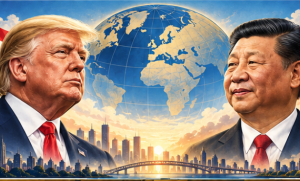
Over the past year, leaders of many major countries have visited China. Even amid a standoff of war and peace with Iran, U.S. President Trump visited Beijing, and Trump recently thanked Chinese President Xi Jinping for helping resolve the dispute between the U.S. and Iran. It goes without saying that China and the United States have become the world’s two major powers, forming a G2. However, achieving this status was by no means easy; China has stood out bit by bit while enduring various external suppressions throughout the American Century—a true reflection of the saying that “hardships bring prosperity to a nation.”
Since the late 19th century, the United States has been the world’s largest economy and a major victor in both World Wars of the 20th century. During the Cold War following World War II, although the Soviet Union rivaled the U.S. militarily and politically, the United States maintained a consistent lead in the economy and civilian technology. It led the Western bloc in successfully restoring economic strength, ultimately forcing the Soviet Union to collapse as it could no longer afford the arms race. After the 1990s, the United States became the world’s sole superpower, establishing military bases worldwide, acting as the “world’s policeman,” and evangelizing its liberal democratic ideology to all humanity, which scholars regarded as the epitome of the “End of History.” The United States was undoubtedly the most powerful sole hegemony in history capable of dominating the entire world, and the past century can be viewed as the American Century.
When the American Century began, China was plunged into profound suffering. Having suffered years of Japanese aggression, with most of its prime regions occupied and ravaged by Japanese forces, and soon after facing a bloody civil war between the Kuomintang and the Communist Party following the conclusion of the War of Resistance Against Japanese Aggression, China—already lagging in industrialization—became almost the poorest place in the world by the time the People’s Republic of China was founded in 1949.
During the first 30 years of the PRC’s rule, governance primarily followed Marxism. Karl Marx was a compassionate philosopher and revolutionary who had never actually governed a country, and Marxist thought is subject to various interpretations. While it is a worthy governance philosophy to explore, dogmatic interpretations and implementations inevitably led to many shortcomings. Even more disadvantageously, for most of that time, China’s relations with both major powers—the U.S. and the Soviet Union—were extremely hostile. China fought a three-year Korean War with the U.S., and once faced the crisis of potential war with the Soviet Union. Under such conditions, mainland China had to rely on its own efforts. While making significant progress in cutting-edge military technologies such as the “Two Bombs, One Satellite,” little improvement was seen in the people’s livelihood.
Following the reform and opening-up, the livelihood of people in mainland China improved significantly and continuously over the long term, yet the country still endured many tribulations. These included the 1989 Tiananmen Square protests, the 1999 U.S. bombing of the Chinese embassy in Yugoslavia, the 2001 Hainan Island incident (the Sino-U.S. mid-air collision), and the 2008 Wenchuan earthquake in Sichuan (excluding the COVID-19 pandemic, which was global). Even more severely, starting in 2018, the United States—allied with the European Union, Japan, and others—launched trade and tech wars against China. This led to an exodus of foreign capital from China, a contraction of Chinese exports to the U.S., and damage to China’s semiconductor and mobile phone industries. These external pressures compounded China’s domestic challenges, such as the real estate market crash, soaring local government debt, and domestic economic involution.
Having established the American Century, the United States was once the global model. Although the U.S. remains powerful today, it is somewhat hollowed out and is no longer a universal model, leaving it to form a G2 with a rising China. Although mainland China is gradually growing wealthier and stronger, many domestic challenges still need to be resolved. Fortunately, over the past century, China has experienced and overcome countless hardships and trials far more difficult than those it faces today. “Hardships bring prosperity to a nation” captures China’s true portrait and serves as the underlying confidence for its continued rise and ability to surmount various difficulties. In contrast, the rise of the United States was far too easy; the European powers of the time were focused on fighting one another and offered virtually no resistance to America’s ascent.
中美論壇
熱門話題 精彩內容
需要您的共鳴回響與參與才有火花
。。。請熱烈點擊回響 。。。
| #660 佟秉宇 島國焦慮與帝國野心:日本侵略歷史的深層結構分析 |
| #660 盛嘉麟 中國要善用國力處理周邊地緣政治的困境 |
| #660 Kuo Yue-Sun From the American Century to G2: Hardships Bring Prosperity to China |
| #659 張文基 葛如鈞錯了 國民黨不能跟著錯 |
| #659 水秉和 中國刮起了復古風 |
| #659 梅強英 從特朗普國宴致詞到波士頓鴉片王朝 |
♦ 本文內容轉載自 2026/10/31 中美論壇社,不代表本站立場。若有侵害著作權,請速告知,我們將盡速移除 ♦